
電動工具換向器:可靠馬達性能背後的小部件
人們在使用電鑽、角磨機、鋸子、拋光機等電動工具時,通常會注意馬達的功率、速度和耐用性。然而,在許多有刷電動機內部,一個小部件在將電能轉化為機械運動方面發揮關鍵作用——電動工具換向器. Although a commutator is only a small part of the motor assembly, its design directly affects motor efficiency, operating stability, noise level, and service life. In industries that require high-speed rotating equipment, commutator manufacturing involves precise engineering, material selection, and strict quality control.
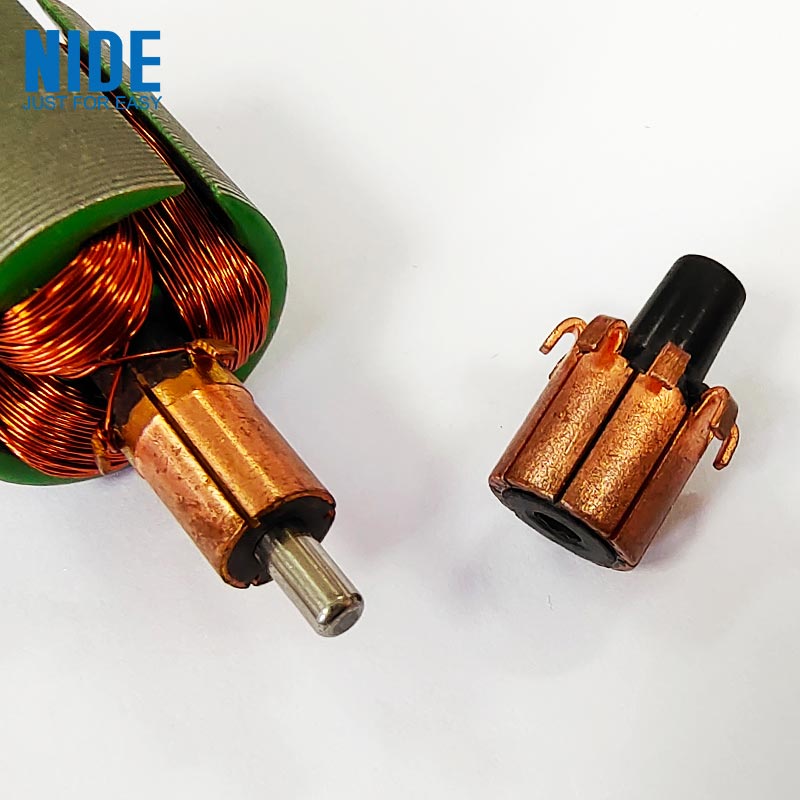
什麼是電動工具換向器?
A 電動工具換向器 is a rotating electrical switching component used in brushed DC motors and universal motors. Its main function is to control the direction of current flowing through the motor windings, allowing the motor rotor to continue rotating. A typical commutator consists of:| 成分 | 功能 |
|---|---|
| 銅段 | 在電刷和轉子繞組之間傳導電流 |
| 絕緣材料 | 以電氣方式分離各個銅段 |
| 核心結構 | 為旋轉操作提供機械支撐 |
| 連接端子 | 連接換向器與馬達繞組 |
為什麼換向器在電動工具馬達中很重要?
A power tool motor operates under demanding conditions: High rotational speed Frequent starting and stopping Heavy mechanical loads Continuous vibration The commutator must maintain stable electrical contact during these conditions. A well-designed commutator helps improve: Motor efficiency Rotation stability Electrical conductivity Tool operating life If the commutator surface wears unevenly, it may lead to problems such as: Increased sparks Reduced motor power Excessive heat generation Shortened brush life行業秘密:換向器的表面品質比外觀更重要
A commutator may look like a simple copper component, but its surface condition is extremely important. Motor manufacturers pay close attention to: Segment precision Surface roughness Roundness accuracy Insulation spacing Even tiny manufacturing differences can affect: Contact stability with carbon brushes Electrical resistance Heat generation For high-speed power tools, a small imbalance in the rotating component can create vibration and reduce motor performance.電動工具換向器所用材料
換向器的材料組合決定了其電氣和機械性能。銅段
Copper is commonly used because of its: High electrical conductivity Good thermal performance Suitable mechanical properties絕緣材料
Insulation between copper segments prevents electrical short circuits. Common materials include: Mica High-temperature insulating compounds特種合金材料
Some applications use copper alloys to improve: Wear resistance Mechanical strength High-speed performance電動工具換向器的製造過程
生產可靠的換向器需要多個精密製程。銅段成型
根據馬達設計要求,銅片被成型為精確的段。成型與組裝
銅片用絕緣材料固定,形成完整的旋轉結構。機械加工和表面處理
The commutator surface is precisely processed to ensure: Correct diameter Smooth contact surface Stable rotation測試
Quality inspections may include: Dimensional measurement Electrical conductivity testing Insulation testing Dynamic balance testing換向器與無刷馬達技術
隨著無刷馬達技術的發展,一些現代電動工具已經取代了傳統的有刷馬達。 差異包括:| 特徵 | 帶換向器的有刷電機 | 無刷電機 |
|---|---|---|
| 結構 | 使用電刷和換向器 | 採用電子控制系統 |
| 維護 | 隨著時間的推移需要更換刷子 | 通常機械磨損較低 |
| 成本 | 更經濟的設計 | 技術要求較高 |
| 應用 | 常見於許多傳統電動工具 | 越來越多地用於高級工具 |
